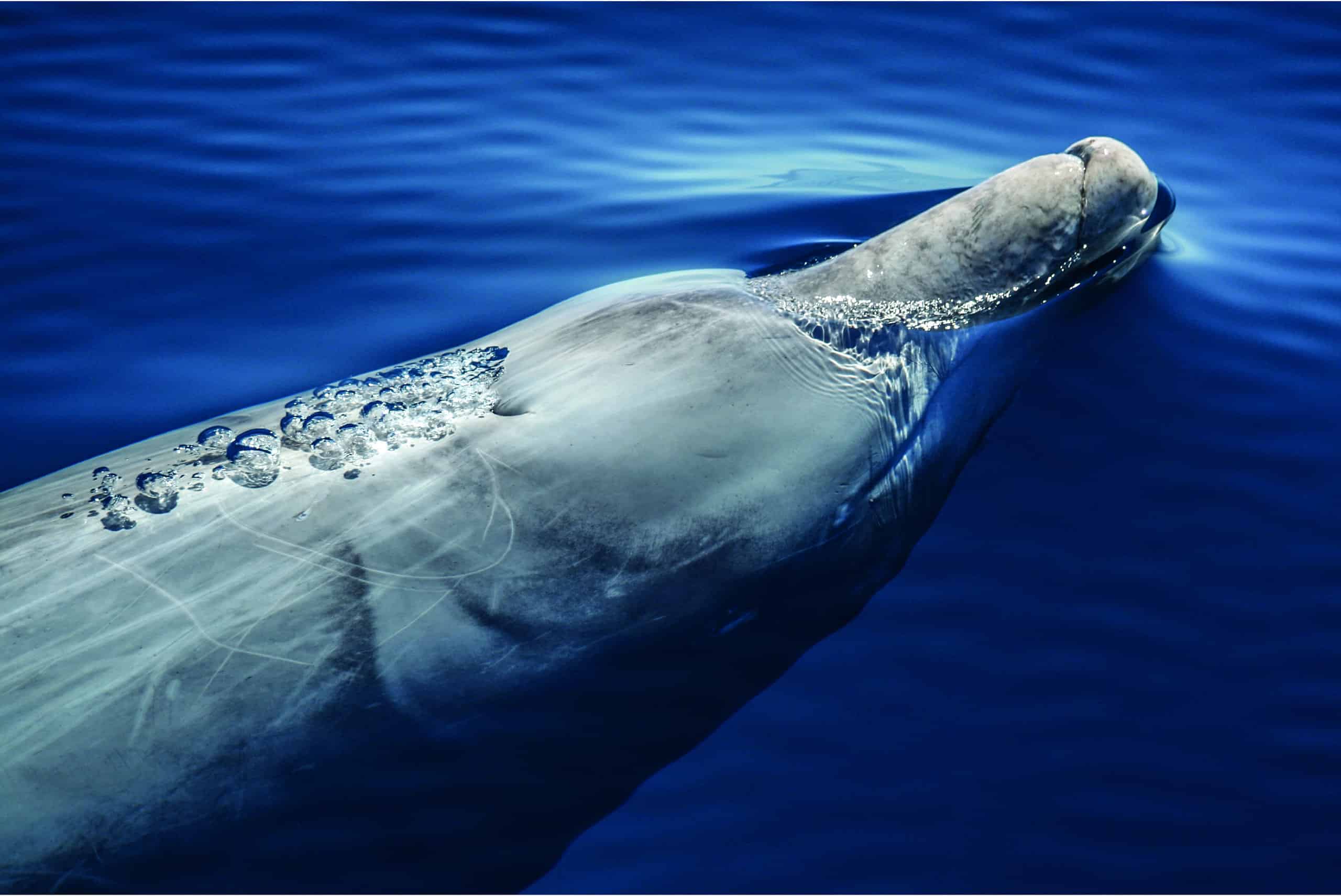
The idea for the show, funded by CIMA Research Foundation, emerged as a way to publicise information connected with the Pelagos Noise project, where the aim was to understand the impact of sound pollution on the sea mammals in the Pelagos Sanctuary. Organised through a partnership between Italy, France and Monaco, the project also involved three awareness-raising initiatives ‒ one for each country. For Italy and France, workshops were created as part of the Festival of Science in Nice and Genoa. The photographic exhibition focusing on sperm whales and Cuvier’s beaked whales ‒ the two cetacean species most sensitive to underwater noise ‒ was the third initiative, held in Monaco during Ocean Week. The aim was to improve the public’s awareness of the Cuvier’s beaked whale in particular ‒ a species that, generally speaking, is somewhat lesser known than the sperm whale. On show were 11 photographs by CIMA researchers working on the Pelagos Noise project, 12 photographs by researchers connected with ACCOBAMS (Agreement on the Conservation of Cetaceans of the Black Sea, Mediterranean Sea and contiguous Atlantic Area). These were accompanied by a project presentation panel, two others explaining the international research agreements, plus two videos: one with photos taken by a CIMA Research Foundation drone, the other showing spectrograms of the sounds emitted by the mammals, made in collaboration with Econscience, a non-profit organisation focusing on bioacoustics. Visitors were able to listen to the animals’ songs thanks to the terminal set up by Econscience.
Displaying the research results was not only an opportunity to showcase their appeal and underline their importance, but also a way to make people aware of issues close to the heart of CIMA Research Foundation: study of cetaceans is an excellent index for monitoring the state of the marine ecosystem and for identifying what effects human activity has on it. Thanks to the constant exchange of expertise between sectors ‒ a distinctive trait of the CIMA method ‒ a biological approach in the field can also be integrated with engineering know-how, developing effective tools for safeguarding and preserving protected marine species within the framework of a sustainable use of the sea.